Count on Casio calculators, now and forever.
For 60 years, Casio calculators have been easy to read, simple to use and durable. Yet today, we're reimagining their core identity from the ground up for a new future of the calculator. Designed with the spirit of Japanese manufacturing, the Casio calculator of the future will exceed modern expectations as a truly essential item. Casio calculators respond to individual user's needs, and make computation correctly. Casio calculators don't just make computation convenient. Just by owning one, they deliver joy.
CASIO Japan Design
CASIO Japan Design
Casio’s Calculator Business by the Numbers
-

1.8 billion Calculators Sold
Casio has sold a total of 1.8 billion calculators over 60 years. Casio has only been able to achieve its level of sales up to this point thanks to the support of all of its users around the world. Moreover, the company will continue to respond to the needs of the market to develop products that make a positive contribution worldwide.
Note: This figure is based on all calculator models from all regions. (Information is current as of January 2025.)scription goes here -

Available In 116 Countries
This is the number of countries in which Casio’s calculators are used. This number means that Casio covers about 60% of countries and regions globally. With models such as the MJ-120GST, a checking calculator that supports India’s digit display conventions, to scientific calculators in various world languages, Casio’s development efforts demonstrate significant investments in localization for product designs specific to various regions and cultures worldwide.
-

81% Reduction
As Casio turns more attention to the problem of worldwide plastic waste, the company has begun an initiative to reduce the amount of plastic used compared to the past through a conversion to paper packaging.
Casio is in the process of gradually using paper to replace the packaging materials for all of its models sold globally.
By converting to paper packaging, the total amount of plastic used is projected to decrease by approximately 81% compared to the past (based on a comparison among Casio products). As a result, the amount of plastic used is expected to decrease by approximately 353 tons* annually.*Based on production volume for the period from April 1, 2022, to March 31, 2023
These Calculators Are Actually Real!
-

Calculator Designed for Bowling, a Rarity Worldwide
300-A
Bowling enjoyed a boom of popularity in Japan in the 1970s. At Casio, employees were particularly passionate about the game, with company tournaments happening frequently. This enthusiasm led Casio to create a dedicated calculator for bowling. With this device, each player of the game would be assigned a number, and entering the scores for each player would result in a printout of players and their scores in descending order. The calculator was capable of rapidly and automatically determining rankings for up to 181 players, which helped to streamline calculations at bowling alleys and manage private competitions. -

World’s Thinnest Film Calculator at an Astonishing 0.8 mm Thick
SL-800
At the time of this model's release, various manufacturers were frantically competing to see who could produce the thinnest calculator. Casio's efforts to make its calculators smaller and thinner were already well underway, which can be seen through its progression from desktop calculators first, and then on to personal sizes as well as portable and notebook sizes. To further evolve these efforts, the company proudly rolled out the SL-800, which was dubbed an “ultraportable film calculator.” Its thickness was an extraordinarily thin 0.8 millimeters, and it weighed just 12 grams. This made the ultrathin calculator more akin to a credit card in shape. The SL-800's design was made possible through the application of the latest LSI technologies and a liquid-crystal display, allowing it to easily become a part of one's daily life. It would be no exaggeration to say that this model changed the perception of what people could carry around with them. -

Revolutionary Model for Measuring Biorhythms
H-801
While in the midst of its development of many different kinds of calculators, in 1975 Casio put out the H-801 Casio Biolator, a calculator that was capable of measuring biorhythms. The concept of biorhythms enjoyed some popularity in Japan at the time. This theory posited that all people have a sort of cyclical rhythm consisting of different physical, emotional, and intellectual states from the time that they are born, and that the interactions among these different rhythms are responsible for favorable or unfavorable periods in their daily lives. By entering a birthday and the date of the desired calculation, a user could view the condition of their biorhythms on the day in question. The model succeeded in expanding the market for Casio’s calculators through the addition of new functionality to its devices, and was a precursor to the composite products that were to come thereafter.
History of Casio Calculators
-
![]()
This model was the beginning of Casio’s electronic desktop calculator line. Its memory functions made a wide variety of calculations more efficient. The 001 marked the beginning of a new era of calculators.
-
![]()
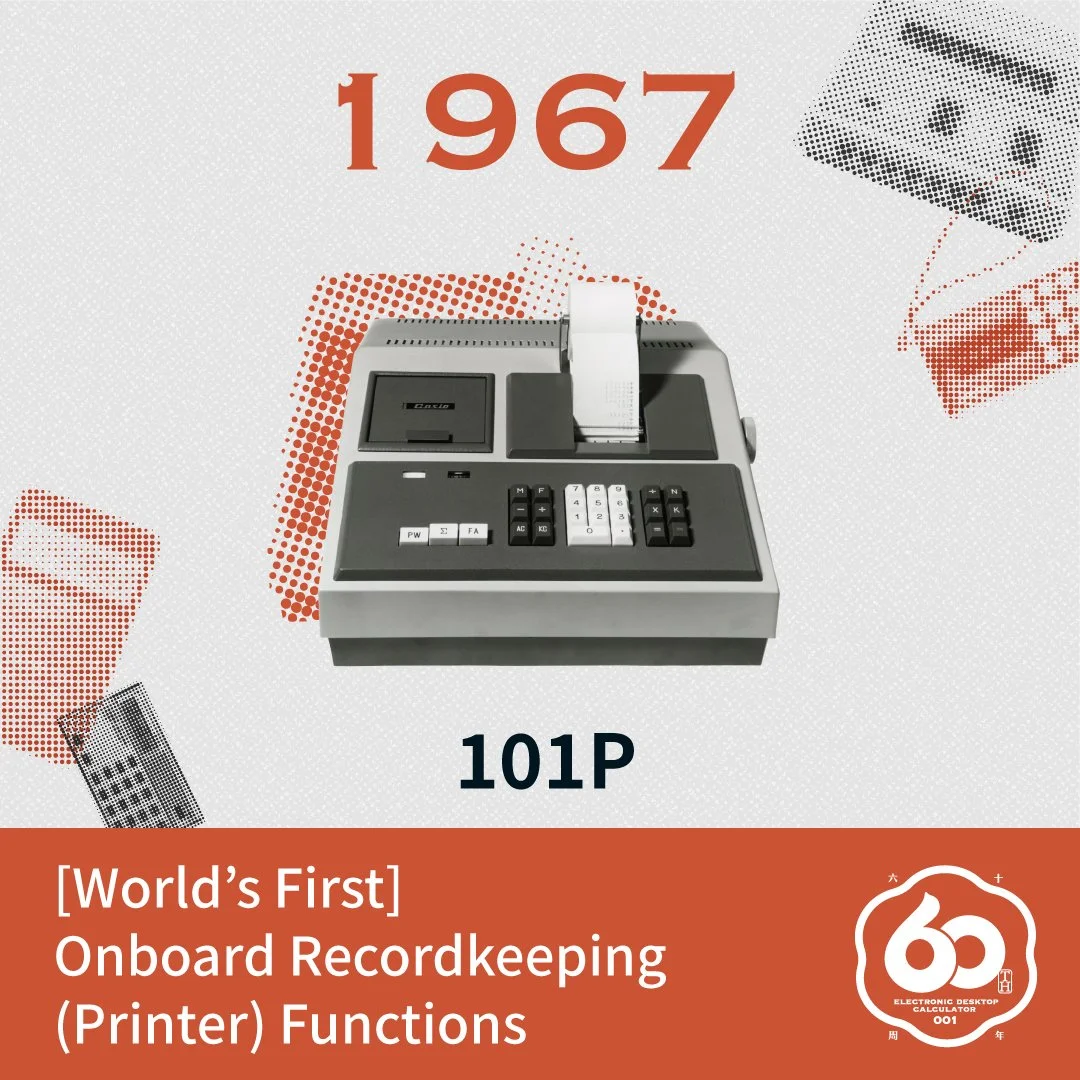
The 101P was capable of printing values and the results of calculations onto a roll of paper, allowing users to check the information later or keep records. This contributed greatly to more efficient work operations and accounting.
-
![]()
This model supported the calculation of 16 types of functions, including trigonometry, logarithms, and cube roots, all accessible from one-touch key operations. The fx-1 was the first in Casio’s revolutionary scientific calculator line.
-
![]()
The Casio Mini is notable for changing the concept of a calculator from a piece of office equipment to an everyday household item. It shocked the industry when it debuted at just one-fourth the size and one-third the price (at ¥12,800 [JPY]) of the mainstream models of the time.
-
![]()
The JS-20 was a solar-powered model at the perfect size for use either on a desktop or in the hands. Its design focused extensively on ease of use and practicality, and contained a wide variety of calculator functions required for business.
-
![]()
Using a film-like approach to the electronic components, the SL-800 achieved a thickness of just 0.8 mm and a weight of 12 grams. This model combined the imagination and technical skills of Japan and was considered to be the ultimate in portable calculators.
-
![]()
The fx-7000G made it easy to display graphs merely by entering a formula, where graphs previously had to be drawn by hand. This model contributed to mathematics education in the United States.
-
![]()
This model sought to build interest in mathematics through, for example, analyzing a photo showing the lines drawn by water in a fountain and then generating a function to describe the phenomenon. It was helpful in supporting learning by reinforcing visual understanding through the use of colors for numerical values and graphs.
-
![]()
The ClassWiz Series aligned with the school curricula in various countries via changes in functionality and language according to the country of use. This series is a collection of standard scientific calculators.
-
![]()
The S100X was designed as the flagship Casio calculator, favorably combining technology and the company’s reputation in a high-quality and easy-to-use model. It has been a popular option as a gift.
-
![]()
The Ergonomic Calculators were created in consideration of ergonomic principles for the vertical pressing of the keys, with the calculator’s operable surface slanting at an incline of three degrees to align with the shape of the hand. With this design, the Ergonomic Calculators indeed offer a new “angle” in its approach to the pressing of keys.